
Relational Wisdom
/Relationships are a unique thing. I have read much about relational health, and I have lived through plenty of successes and failures of my own. Through both, I have often wondered what it actually takes to build and sustain a healthy relationship.
One of the hardest realities of relationships is that each person only has agency over themselves. I cannot change another person any more than I can change the rising and setting of the sun. I can influence. I can encourage. I can confront. I can forgive. I can pray. I can hope for change—but I cannot create it.
Hope is a beautiful thing, but hope is not a relational strategy.
And yet, this is where relationships can get complicated. We often relate to people based on who we hope they will become rather than who their patterns show them to be. We see their potential. We remember the person they used to be. We believe the apology. We know what they are capable of. Sometimes we even take responsibility for helping them become that person.
But healthy relationships require us to hold two truths at the same time: people can change, and I cannot change them.I can leave room for growth without pretending growth has already happened. At some point, relational health requires me to stop building a relationship around who I hope someone will be and begin responding wisely to the patterns they are actually demonstrating.
My husband and I have spent years trying to put language around this in our own relationships. We developed a paradigm that helps us think about the kind of relationship and boundaries that are appropriate based on the patterns of someone's behavior. Just as importantly, it has forced us to become more honest about our own.
The framework comes from the wisdom literature of Proverbs. We went chapter by chapter and paid attention to the descriptions Scripture repeatedly gives of the wise, the foolish, and the evil or wicked. We wrote down the behaviors associated with each and eventually condensed them into a chart.
I'll admit that I initially cringed at the word evil. It feels harsh to put a word like that anywhere near a discussion about relationships. But Proverbs does not shy away from the reality that some human behavior is not merely immature or impulsive. Some behavior is intentionally deceptive, destructive, manipulative, and harmful.
At the same time, these categories were never meant to become permanent labels we slap onto people. They describe patterns.
All of us act foolishly sometimes. Wise people can make foolish decisions. People can mature. People can repent. People can also move in the opposite direction. The important question is not whether someone has ever demonstrated one of these behaviors. The question is: What pattern are their choices creating?
And before this framework gives me permission to examine anyone else's patterns, it requires me to examine my own.
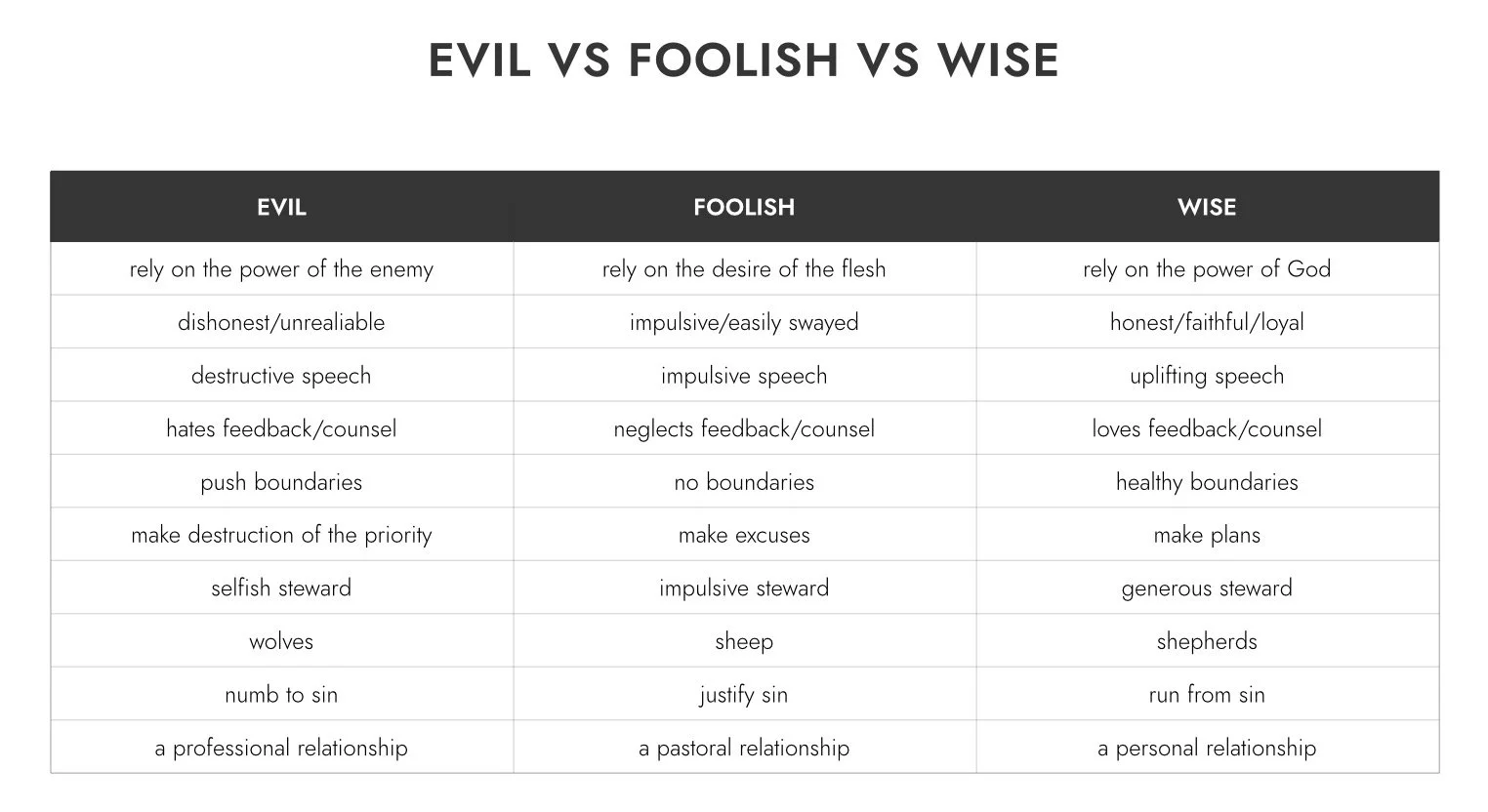
The chart is best read across each row, rather than simply down each column.
Where the evil person is dishonest or unreliable, the foolish person is impulsive or easily swayed, and the wise person is honest, faithful, and loyal. Where the evil person uses destructive speech, the foolish person speaks impulsively, and the wise person uses words to build others up. Where the evil person hates feedback, the foolish person neglects it, and the wise person welcomes counsel. Where the evil person pushes boundaries, the foolish person lives without them, and the wise person establishes healthy ones.
Read this way, the chart begins to reveal something important. Wisdom, foolishness, and evil are not simply ideas or labels. They create recognizable patterns of behavior.
But there is something the chart doesn't show.
Patterns don't exist in isolation. My patterns interact with your patterns. Your choices affect the relationship just as mine do. The way you handle correction affects what I can safely tell you. The way I respond to your vulnerability affects what you will trust me with next time. How each of us responds to disappointment, disagreement, failure, boundaries, forgiveness, and responsibility shapes what kind of relationship can actually exist between us.
Different combinations of patterns therefore create very different relational possibilities.
Wise + Wise: Authentic Relationship
When two people are consistently choosing wisdom, a deep and authentic relationship becomes possible.
The word possible matters. Two healthy people are not guaranteed to become best friends. But wisdom creates the conditions in which a healthy, authentic relationship can grow.
Both people can receive feedback without viewing correction as rejection. Both can own their mistakes. Both understand that boundaries aren't abandonment. They can disagree without needing to destroy one another or the relationship. Neither person has to constantly protect an image of themselves because both are more interested in becoming healthy than appearing right.
This is fertile ground for trust, and trust allows a relationship to become increasingly honest, mutual, vulnerable, and deep.
Wise + Foolish: Mentoring Relationship
When one person is consistently operating with wisdom and the other is consistently making foolish choices, the healthiest relationship often looks less like friendship and more like mentorship.
That doesn't mean one person has more value than the other. Equal value does not require equal access, equal influence, or equal trust.
A wise person can deeply love someone who is behaving foolishly without pretending the relationship currently has the mutuality necessary for deep friendship. There may need to be greater boundaries around what is shared, how much influence is given, or how much responsibility is entrusted.
The mentorship I am describing is also bigger than teaching a skill. You can teach someone how to do something without having much influence over who they are becoming. This kind of mentorship involves character. It requires enough trust for one person to challenge another person's thinking, decisions, patterns, and responses.
And the goal isn't to keep the relationship there forever.
The hope is growth.
Wise + Evil: Boundaried Relationship
This may be one of the hardest relationships for loving people to accept.
When someone repeatedly demonstrates destructive patterns—deception, manipulation, attacking boundaries, refusing accountability, intentionally harming others—the wise response is not greater access.
It is stronger boundaries.
Sometimes we mistakenly believe that loving someone means continually giving them another opportunity to hurt us. We confuse forgiveness and grace with trust and unrestricted access. But love does not require unlimited access. Forgiveness does not automatically restore trust. Grace does not eliminate boundaries.
In this relationship, the wise person carries the responsibility of establishing and maintaining healthy boundaries precisely because the destructive person may continually push against them. When you do this, expect an attack and have a gracious response. Their patterns will lead to them attacking the YOU when they can’t attack the boundaries you put in place.
That isn't hatred or revenge. It is choosing to see the relationship truthfully and responding to what is actually happening rather than what we wish were happening.
Foolish + Foolish: Fragile Relationship
Two foolish people can actually feel incredibly close.
They can laugh together, agree together, complain together, affirm each other, and genuinely enjoy being together. The relationship can feel deep because there is a tremendous amount of agreement.
Until there isn't.
When disagreement comes, the relationship is tested. When one person needs to hear something they don't want to hear, the relationship is tested. When expectations aren't met or one person establishes a boundary the other doesn't like, the relationship is tested.
If neither person has learned to receive correction, take responsibility, maintain boundaries, or tolerate disagreement, the relationship may only be as strong as the things they agree upon.
They can mistake agreement for intimacy. Real intimacy has to survive truth.
Foolish + Evil: Vulnerability to Manipulation
This combination can become particularly dangerous.
The person demonstrating foolish patterns may struggle to maintain boundaries, recognize destructive behavior, listen to wise counsel, or think beyond the emotion of the moment. The person demonstrating evil patterns pushes boundaries, manipulates, deceives, or uses others for personal gain.
Put those patterns together and there is significant vulnerability to manipulation, control, and even abuse.
This doesn't mean every foolish person in relationship with a destructive person will experience abuse. It means the conditions make exploitation easier. One person keeps pushing while the other doesn't know how—or isn't yet willing—to hold the line.
This is one reason growing in wisdom matters far beyond ourselves. Wisdom doesn't simply help us make better decisions. It helps us recognize when someone else's decisions require a boundary.
Evil + Evil: Destructive Relationship
When two people consistently choose destructive patterns, the damage rarely remains contained between them.
Deception meets deception. Manipulation meets manipulation. Self-interest meets self-interest. Retaliation escalates retaliation. Instead of one person's health challenging the other's destructive behavior, the patterns begin to reinforce one another.
Eventually, there is collateral damage. Families feel it. Children feel it. Teams feel it. Organizations feel it. Friendships surrounding the relationship feel it.
Two people committed to destructive patterns can multiply destruction far beyond themselves.
You Don't Get to Choose the Other Person's Column
This is where the framework becomes uncomfortable.
We cannot choose another person's patterns for them. We can counsel them. We can encourage them. We can forgive them. We can confront them. We can pray for them. We can give them opportunities to change.
But eventually, they choose.
And so do we.
We choose whether we will acknowledge what their choices are showing us and respond appropriately.
If someone consistently behaves foolishly, wisdom doesn't require me to reject them. But it may require me to stop pretending we have the kind of relationship that only two wise people can sustain.
If someone repeatedly demonstrates destructive behavior, wisdom doesn't require me to hate them. But it may require significant boundaries.









Learning is living and I like living, so I admit I will always be in process. Here is a little something I am learning this week.